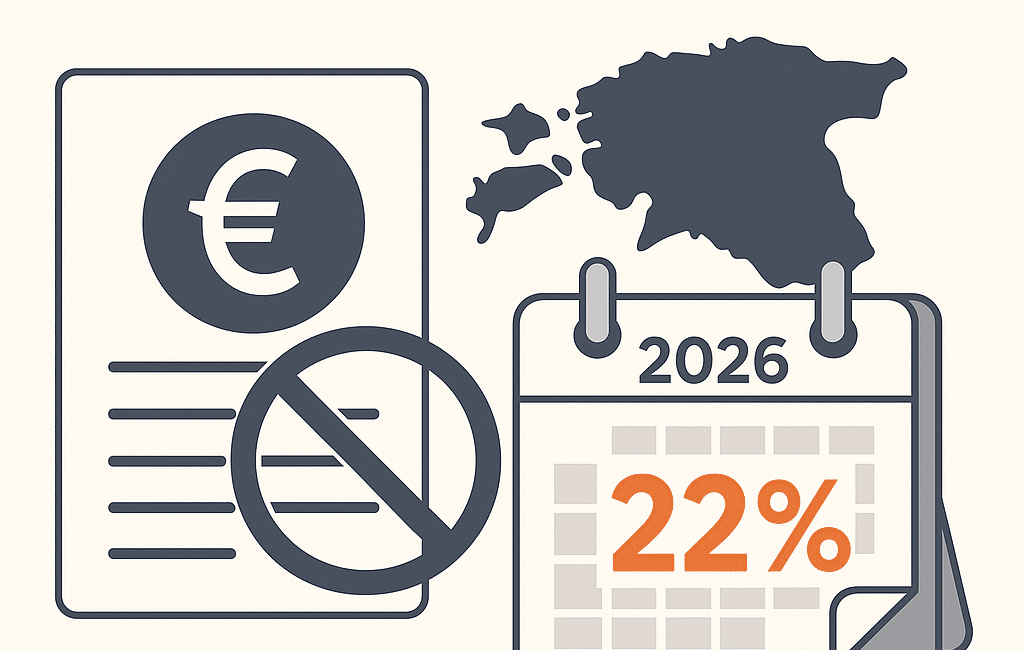
From 1 January 2026, Estonia will completely change the way the tax-free basic allowance for personal income tax works. The so-called “tax hump” (Estonian: maksuküür), under which the amount of the tax-free allowance depended on annual income and gradually tapered down to zero, will be abolished. Instead, a single tax-free allowance of €700 per month (€8,400 per year) will be introduced for all working tax residents.
At the same time, the personal income tax rate will remain at 22%, even though an increase to 24% had previously been planned. The government has confirmed in the draft state budget for 2026 that this increase will not go ahead.
Let’s look at how the “tax hump” used to work, what exactly will change from 2026, and how this will affect employees, entrepreneurs and OÜ owners.
What is the “tax hump” and how did it work before 2026?
The “tax hump” is a system of differentiated tax-free allowance that has been in place in Estonia since 2018.
In essence, it worked as follows:
for low annual income, the maximum tax-free allowance was applied;
as income increased, the amount of the tax-free allowance gradually decreased according to a special formula;
with a sufficiently high annual salary, the tax-free allowance was reduced to zero and the entire income was taxed at a rate of 20–22% (depending on the year).
This led to several effects:
the system was difficult to understand: it was hard for people to estimate how much they would actually take home if their salary increased;
additional earnings within a certain income range were almost entirely “eaten up” by the reduction of the tax-free allowance;
accountants and employees had to keep track of the formulas, check the calculations and adjust their applications for the tax-free allowance.
In other words, the idea was social (more relief for low incomes), but the way it was implemented was complex and non-transparent.
What will change from 2026: a single €700 tax-free allowance and the abolition of the “tax hump”
From 1 January 2026, amendments to the Income Tax Act will enter into force, significantly simplifying the system. A detailed overview has been published by the Estonian Tax and Customs Board (EMTA).
General tax-free allowance for residents:
€700 per month,
€8,400 per year,
does not depend on the amount of income.
For people of retirement age, a higher tax-free allowance is maintained:
€776 per month,
€9,312 per year.
The “tax hump” is abolished:
there is no longer a formula under which the tax-free allowance “melts away” as income increases;
every working resident is entitled to the same basic tax-free allowance.
The personal income tax rate remains 22%:
the planned increase to 24% in 2026 will not be implemented;
the 22% rate applies both to individuals and to companies.
In practice, this means: whether you earn €800, €1,800 or €3,800 per month, you have the same basic tax-free allowance of €700 (if you are a resident and not yet of retirement age).
Who benefits from the abolition of the “tax hump”?
In practice, the changes affect different groups of taxpayers in different ways.
Low incomes (up to ~€1,200 per month)
For people with lower salaries, a high tax-free allowance already applied before. After the reform:
the tax-free allowance is fixed at €700,
for this group the effect is either neutral or slightly positive (the exact impact depends on their 2025 income and on how the tax-free allowance was used).
It is important that the system becomes simpler: you no longer have to worry about whether you have “slipped” into an income range where the tax-free minimum starts to decrease.
Middle incomes (approximately €1,500–3,000 per month)
This is the group that most often suffered from the “tax hump”: part of the tax-free allowance was “eaten up” by the formula, and the effective tax burden within a certain income range was higher.
After the tax hump is abolished:
people in this income range receive a stable tax-free allowance of €700,
their effective tax rate decreases,
their net salary increases, especially if a significant part of the tax-free allowance had already been lost under the previous formula.
High incomes (from around €3,000–3,500 per month and above)
Previously, once income exceeded a certain threshold, a person lost the right to any tax-free allowance and all of their income was taxed at the full income tax rate.
From 2026:
even with high incomes, a resident is entitled to €8,400 of tax-free income per year;
the saving can be up to €1,848 per year (22% of €8,400) if the full tax-free allowance is used during the year.
How personal income tax will be calculated from 2026: a simple logic
For most employees, the formula becomes intuitive:
Tax base = monthly income – €700 (if you apply the tax-free allowance with this employer)
Income tax = 22% × tax base
Important nuances:
the €700 tax-free allowance is applied with one payer of income only, i.e. the one to whom you have submitted an application (avalduse maksuvaba tulu rakendamiseks);
if you work in several places, the tax-free allowance can only be applied with one of them;
if you have not used the full tax-free allowance during the year, the final calculation is made in the annual tax return and part of the tax may be refunded.
Example 1: salary of €1,200 per month
Let’s assume you have one employer, you are a resident, not a pensioner, and you have submitted an application to apply the €700 tax-free allowance.
Monthly income: €1,200
Tax-free allowance: €700
Tax base: 1200 – 700 = €500
Income tax: 500 × 22% = €110
Other deductions (pension contributions, social tax) are not considered here; we are only talking about personal income tax.
Example 2: salary of €2,000 per month
Income: €2,000
Tax-free allowance: €700
Tax base: €1,300
Income tax: 1300 × 22% = €286
Previously, with this level of salary, part of the tax-free allowance could already have been “cut” by the formula. Now the scheme is transparent and easy to understand.
Example 3: salary of €3,500 per month
Previously, at this level of income, the tax-free allowance was generally already zero. From 2026:
Income: €3,500
Tax-free allowance: €700
Tax base: €2,800
Income tax: 2800 × 22% = €616
In practice, a person with a high salary now gets the same “bonus” in the form of a tax-free allowance as everyone else.
⚠️ Key Detail: these are simplified examples. The actual calculation may differ if you have:
several sources of income;
entrepreneurial or business activity;
additional deductions (mortgage interest, donations, etc.). In these cases, the final amount is adjusted through the annual tax return.
What employees need to do in 2025–2026
To make proper use of the new tax-free allowance, it makes sense to check a few points.
1. Check your tax-free allowance application with your employer
From 2026, the maximum tax-free amount is €700 per month. If your previous application said something like “maksuvaba tulu seadusega ettenähtud määras” (“at the amount provided by law”), your employer can apply €700 automatically without a new application.
But if:
you previously asked for a lower amount to be applied (for example, €300);
or you asked not to apply the tax-free allowance at all;
— then it makes sense to submit a new application with the updated amount.
2. If you have several employers
The tax-free allowance can be applied with only one employer. Therefore:
choose the employer where your salary is higher and more stable;
make sure that you have submitted the tax-free allowance application only to that employer;
if in a given month the allowance has not been fully used, the adjustment will be made in the annual tax return.
3. Keep an eye on your 2026 tax return
The tax return for 2026 is filed from 15 February 2027. In it, the EMTA will automatically apply the €8,400 tax-free income, regardless of the total amount of your income. If tax has been withheld with a buffer during the year, part of it can be refunded via the tax return.
What employers and OÜ owners need to keep in mind
For employers and owners of Estonian companies, these changes are a good reason to review how payroll processes are set up and how you communicate with employees.
1. Update payroll systems and templates
You need to make sure that from 1 January 2026:
the payroll software takes into account the single tax-free allowance of €700;
there are no old “tax hump” formulas left in use;
TSD and other reports are generated with the correct amounts.
2. Inform employees
It is good practice to send out a short explanation:
that the “tax hump” is being abolished;
that everyone will have a single tax-free allowance;
how employees can update their applications if needed.
This reduces the number of questions for the accounting team and helps avoid errors in applying the tax-free allowance.
3. Recalculate the payroll budget and benefits
Since the income tax rate remains at 22% and the tax-free allowance increases and becomes unified, many employees will see their take-home pay rise without any increase in their gross salary.
This is a good moment to:
review the structure of compensation;
plan the budget for 2026;
if necessary, adjust offers and HR communication (since “take-home pay” will change).
Frequently asked questions about the abolition of the “tax hump” in Estonia
Do I need to submit a new application for the tax-free allowance?
Not always. If your application already states that the employer should apply the tax-free allowance “at the amount provided by law”, then from 2026 they can simply use €700 without a new application. If you specifically indicated a lower amount or 0, it makes sense to submit a new application.
What if I have two jobs?
The tax-free allowance can be applied with only one employer. If you have submitted applications to two employers, a tax shortfall may arise by the end of the year and you will have to pay the difference in your tax return. It is therefore better to choose one employer and use the full allowance there.
What happens if the tax-free allowance was applied incorrectly during the year?
The final calculation is still made in the annual tax return:
if less than the full allowance was applied, part of the tax will be refunded;
if more was applied (for example, simultaneously with two employers), you will have to pay the difference.
It is therefore important to keep track of your applications and clearly indicate with which employer you want to use the tax-free allowance.
Does anything change for the entrepreneurship account (ettevõtluskonto)?
The main changes concern the basic tax-free allowance and the abolition of the “tax hump”. The rate for the entrepreneurship account remains linked to the same general personal income tax rate of 22% (and not 24% as previously planned).
Need help with tax calculations and planning?
The abolition of the “tax hump” makes the system simpler, but:
if you have several sources of income;
you combine salaried work with running a business through an OÜ or an entrepreneurship account;
you are planning large dividends, asset sales or entering the Estonian market,
— it makes sense to calculate different scenarios in advance and understand how the 2026 changes affect your specific situation.
Accounting Resources Nola OÜ helps residents and owners of Estonian companies:
assess how the new rules affect your net income;
set up payroll processes and tax returns;
build a tax-efficient and compliant payment structure.
Contact us to discuss your situation and get ready for 2026 with no surprises.